How to Read Your Free Water Test Results
Eleven numbers come off the printer in about a minute. Here is what the four that matter most are telling you.
September 15, 2026 · 3 min read
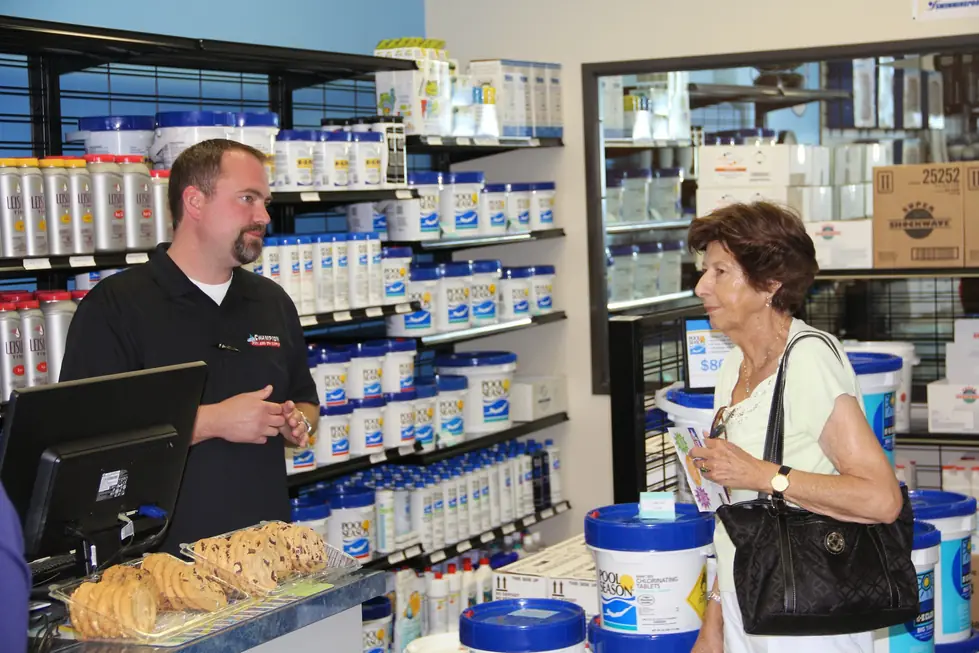
A customer came in last week holding a mason jar of cloudy pool water and admitted she had no idea what any of it meant, she just knew her kids were rubbing their eyes after ten minutes in the water. Five minutes and a printout later, she had an answer. That printout is the whole point of the free water test, and it is worth understanding what it is actually telling you rather than just handing it to someone at the counter and waiting.
What the Test Actually Does
We run water samples through Xpress Flex, a computerized system that uses lighting and imaging technology to read a sample and return results for up to eleven separate measurements in about a minute. It is fast because it has to be. Nobody wants to stand at a counter for twenty minutes waiting to find out why their eyes sting. Once the results print, we walk through the water balance recommendations with you and explain the treatment steps in plain terms, not just a list of product names to buy.
Bring your sample from about elbow depth, away from the skimmer and away from the return jet, in a clean container with a lid. Water pulled from right at the surface or right next to a jet gets you a reading of whatever chemical was added most recently rather than the water as a whole, and that throws off everything downstream.
The Numbers That Actually Drive Decisions
- Free chlorine: the chlorine actively available to sanitize. This is the number that matters for swimming, not total chlorine.
- Total chlorine minus free chlorine gives you combined chlorine, the used-up chlorine bound to contaminants. A gap here, along with a sharp chemical smell, usually means it is time to shock the water rather than add more chlorine on top.
- pH: most pools run comfortably between 7.2 and 7.8. Below that range chlorine burns through fast and metal fittings corrode. Above it, chlorine stops working efficiently and swimmers get itchy skin and cloudy water.
- Total alkalinity: this is what keeps pH from swinging every time you add a chemical or it rains. Low alkalinity means your pH will bounce around no matter how carefully you dose it.
- Calcium hardness: too low and the water pulls calcium out of your plaster and grout to compensate, which is how pools develop pitted or etched surfaces over years. Too high and you get scale on tile lines and equipment.
These numbers are not independent of each other. Alkalinity is the buffer that holds pH steady, so if your pH keeps drifting no matter how much acid or soda ash you add, the real fix is usually alkalinity, not another dose of pH adjuster. That is the kind of thing that is hard to see from a single number and easy to see once someone walks you through the whole printout.
What Happens After the Printout
The results sheet is not the finish line, it is the starting point for a short conversation. We will tell you what order to add things in, because dosing chemicals in the wrong sequence can waste a product or, in some combinations, undo what you just fixed. If your numbers are consistently drifting the same direction test after test, that is often a sign of something mechanical, a filter running too long between cleanings, a pump undersized for the pool, rather than a chemistry problem you can dose your way out of.
The test itself is free every time, and if you are testing regularly it is worth asking about the Way-2-Save chemical discount program, ten percent off chemicals for a year for a nine dollar and ninety-nine cent membership. Most people do not need to memorize any of this. Bring a sample by, and we will tell you what it says.
Champion Pool and Spa Supply, (520) 829-6400
Call (520) 829-6400More articles
What Tucson Summers Do to Your Pool Water
Heat burns off chlorine faster than most owners expect, and the monsoon brings its own problems in on the wind.
Sand vs. Aquarium-Grade Filter Media: Is Your Filter the Real Problem?
Before you dump more chemicals at cloudy water, it is worth finding out whether the filter is actually doing its job.